
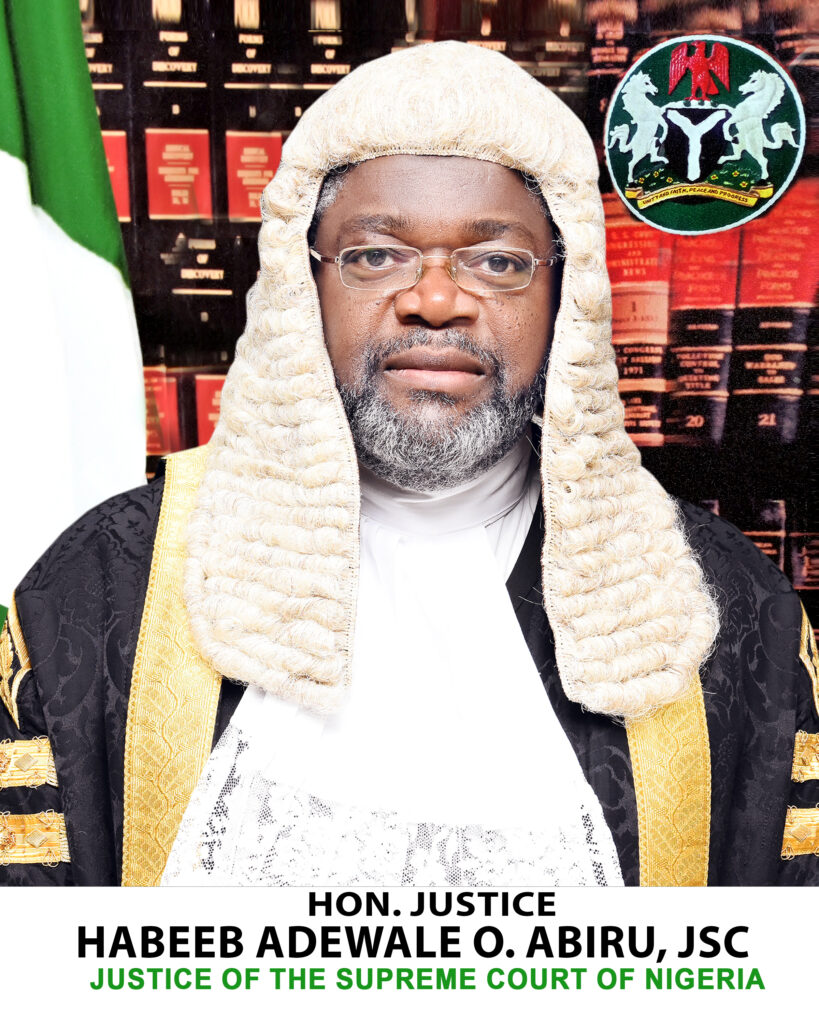
Born on October 17, 1964, in Lagos State, Nigeria. His academic journey commenced at the Federal Government College, Warri, where he obtained his West African School Certificate. He then proceeded to the University of Ife, now Obafemi Awolowo University, Ile-Ife, where he earned his Bachelor of Laws (LL.B) degree in 1984.
After completing his professional training at the Nigerian Law School, Lagos, he was called to the Bar in 1985. He further advanced his legal education by obtaining a Master of Laws (LL.M) degree from the same university in 1987. His dedication to professional development led him to become a Member of the Chartered Institute of Arbitrators (UK) in 2006 and a Fellow of the Nigerian Institute of Chartered Arbitrators in 2016.
Hon. Justice Abiru began his legal career as a Legal Officer with the Savannah Sugar Company Limited in Numan, Taraba State, during his National Youth Service Corps (NYSC) year. Upon completion of his service, he gained invaluable experience as a Junior Counsel at Messrs. G.O. Oduwole & Co., Lagos, before moving on to become a Senior Associate and Head of Chambers at Messrs. Bentley, Edu & Co. His expertise and leadership skills led him to establish Messrs. M.A.O. Abiru & Co., where he served as Managing Partner from 1997 to 2001. He also made notable contributions to legal education as a lecturer at the Lagos State University, Ojo, before his appointment to the Lagos State Judiciary as a Judge of the High Court in May 2001.
During his tenure on the High Court Bench, he presided over various divisions, including Lands and Chieftaincy Matters, General Civil, Family, Probate, and Criminal Divisions, across judicial divisions in Ikeja, Badagry, Lagos, and Ikorodu. His judicial acumen earned him appointments to several election tribunals, including the Governorship and Legislative Houses Election Tribunal in Abakaliki, Ebonyi State, and the Local Government Elections Appeal Tribunal in Lagos State.
In November 2012, he was elevated to the Court of Appeal, where he served in multiple divisions, including Akure, Kaduna, Jos, Kano, Yola, and on the Sharia Panel of the Court of Appeal. His vast experience and unwavering commitment to justice led to his appointment as a Justice of the Supreme Court of Nigeria in February 2024.
Beyond his judicial duties, Hon. Justice Abiru has played an instrumental role in legal reforms and judicial administration. He has been a member of several committees, including the High Court of Lagos State Civil Procedure Rules Review Committee, the Public Complaints and Training Committee, the Committee on the Lagos Settlement Week, and the Committee on ICT for both the Lagos State Judiciary and the Court of Appeal. His expertise in asset recovery and financial crimes saw him contribute to the Working Group on Stolen Assets Recovery and the Management of Proceeds of Crime, set up by the Attorney General of the Federation.
A prolific writer and speaker, Hon. Justice Abiru has presented numerous papers on diverse aspects of law, ranging from judgment writing and interlocutory applications to fundamental rights enforcement and admissibility of evidence. His scholarly contributions include published works on jurisdiction, contempt of court, asset recovery, and public interest litigation.
His commitment to public service extends beyond the judiciary. He has been actively involved in several non-governmental organizations, including the Movement for Islamic Culture and Awareness (MICA), where he served as National President, and the Muslim Welfare Fund (MUWELF), where he is a member of the Executive Management Committee and Board of Trustees. He is also a member of the Consultative Group of the Muslims in South West Nigeria (MUSWEN) and the Nigeria Supreme Council for Islamic Affairs (NSCIA).
Hon. Justice Abiru’s judicial philosophy is rooted in integrity, fairness, and the unwavering pursuit of justice. His extensive experience across various judicial levels, coupled with his scholarly contributions and commitment to legal reforms, continues to shape Nigeria’s jurisprudence and strengthen the justice system.